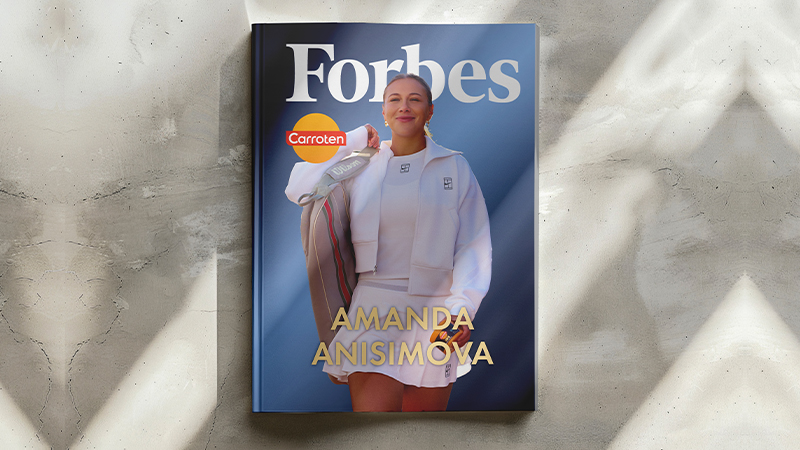
Forbes doesn’t write about tanning products. It writes about market shifts. So when Carroten — a Greek sun care brand that entered the U.S. market two years ago — earned a feature alongside a three-year ambassador deal with Amanda Anisimova, it wasn’t a beauty story. It was a category story.
The sun care and tanning category in the United States grew 11.9% in combined platform popularity over the past year, according to Spate’s Popularity Index, which tracks consumer interest across Google, TikTok, and Instagram. That’s meaningful growth for a category that most of the industry still treats as seasonal. But one brand didn’t just ride the wave — it drove it.
Carroten posted a 282.1% year-over-year increase in popularity — the single largest brand gain in the entire sun care and tanning category. Not the largest gain among newcomers. The largest gain, period.
What follows is a look at what actually produced that number, what it signals about where the sun care category is heading, and what other beauty brands can learn from the strategy behind it.
The Category Is No Longer Seasonal
For decades, sun care was a summer aisle. Brands launched in April, promoted through July, and cleared inventory by September. The entire go-to-market model was built around a four-month window.
That model is breaking. Spate’s data shows that consumer interest in sun care now sustains year-round, driven in large part by the skinification of the category — the idea that sun protection and tanning products belong in a daily skin care routine, not just a beach bag. Search interest for SPF-adjacent terms holds steady through the fall. Tanning products spike earlier each year.
The brands positioned to capture that shift are the ones that understood it first. Carroten did.
Format Over Ingredients: Why Tanning Gel Changed the Conversation
The traditional tanning market was built around oils. Thick, greasy, heavily fragranced products that hadn’t meaningfully evolved in a generation. The experience of using them was, for many consumers, the barrier to using them at all.
Carroten entered the U.S. at $29.99 in a category where competitors priced between $7 and $15. On paper, a premium tanning product from a brand with zero domestic awareness shouldn’t have worked. The price point alone should have been disqualifying.
What the price point missed was format. The Intensive Tanning Gel and Gold Shimmer Intensive Tanning Gel weren’t competing with traditional tanning oils. They were replacing them. A lightweight, fast-absorbing gel that delivers visible results without the residue — that’s a different product in a consumer’s mind, even if it occupies the same shelf.
Format innovation gave Carroten permission to price at a premium. It also gave creators something to demonstrate on camera — which turned out to be the more important advantage.
The TikTok Infrastructure That Built the Brand
TikTok now accounts for over 91.6% of Carroten’s total platform popularity share, according to Spate. That is not a social media strategy. That is a distribution channel masquerading as a content platform.
The numbers behind it: 152.7 million TikTok views. Over 13,300 creators producing content around the brand. And crucially, the content wasn’t promotional — it was demonstrative. Creators applied the gel, showed the texture, filmed the shimmer. The product performed on camera because the format was designed to be visual. That isn’t luck. It’s product-market fit for a creator economy.
But virality without infrastructure is awareness with no return. The critical piece of the Carroten strategy wasn’t the TikTok views. It was what happened after them.
Consumers didn’t just watch the content. They searched for the product by name. “Carroten tanning gel.” “Carroten gold shimmer tanning gel.” Those are purchase-intent queries — the moment a viewer becomes a buyer. And when they searched, the marketplace infrastructure was ready: optimized Amazon listings, TikTok Shop presence, and a retail footprint at Target that had been built in parallel.
The signal chain is what matters: TikTok tells you a product is discoverable. Google tells you a consumer has intent. A fully optimized marketplace presence tells you they can actually convert. Most beauty brands invest everything in the first layer and underinvest in the last.
From Digital Momentum to Retail Credibility
In 2024, Carroten had no U.S. retail presence. By the end of 2025, it held 24% market share in the Amazon tanning category, had generated 224% year-over-year revenue growth, moved 757,000 units, and earned shelf space at Target.
The retail story is instructive. Carroten didn’t enter Target because of a buyer relationship or a trade spend commitment. It entered because the digital performance data made the argument before anyone walked into a meeting. Amazon sales velocity, TikTok search volume, and consumer demand signals gave Target buyers the evidence they needed to justify the placement. The brand moved from bottom shelf to third shelf — eye level — based on sell-through performance.
Digital success became retail credibility. The brands that understand this don’t treat channels as separate strategies. They treat them as a single system where momentum in one channel compounds in the next.
What the Amanda Anisimova Partnership Signals
Amanda Anisimova is ranked No. 12 on Forbes’ Highest-Paid Female Athletes list. Her partnership portfolio includes Nike, Tiffany & Co., Wilson, and Vita Coco. She is, by any measure, selective about the brands she represents.
When she told Forbes that Carroten is “a real partnership that fits naturally into my life,” that specificity matters. Athletes at her level have agencies that vet every deal. An endorsement is transactional. A partnership that “fits naturally” is a product and positioning win — it means the brand earned its place in her routine before the contract was signed.
The three-year term of the deal is equally telling. Short-term ambassador agreements are common in beauty. A three-year commitment signals that both sides believe the brand’s trajectory is sustainable — that this is a growth story, not a moment.
What Other Brands Can Learn
Carroten’s trajectory is specific to its category, its product, and its timing. Not every sun care brand — or beauty brand — can replicate it. But the strategic principles underneath are transferable.
Format innovation creates pricing permission. Carroten didn’t win by competing on price in an existing format. It introduced a new format that redefined what the consumer was buying. The premium price point followed naturally because the comparison set changed.
Product-market fit for TikTok is about demonstration, not promotion. The brands winning on TikTok have products that are visually demonstrable. Texture, application, transformation — these are the moments that generate organic creator content. If your product doesn’t perform on camera, no amount of paid seeding will make up the difference.
Virality is worthless without conversion infrastructure. The gap between being seen and being searched is where most brands lose momentum. And the gap between being searched and being ready to sell is where revenue is left on the table. Optimized marketplace listings, TikTok Shop presence, and retail availability have to be in place before the content wave hits.
Digital performance earns retail placement. Retail buyers increasingly use digital demand signals as the basis for shelf decisions. A brand with strong Amazon velocity, rising search volume, and creator-driven awareness walks into a buyer meeting with evidence, not a pitch.
Authenticity in partnerships is measurable. When an ambassador describes a brand deal as something that “fits naturally into my life,” the market can tell the difference between that and a scripted endorsement. Brands that invest in relationships that feel real to the public generate more sustained engagement than those that purchase awareness through transactional deals.
The sun care category is evolving faster than most of the industry recognizes. The brands that win in the next cycle will be the ones that understood, before anyone else, that this is no longer