Executive Summary
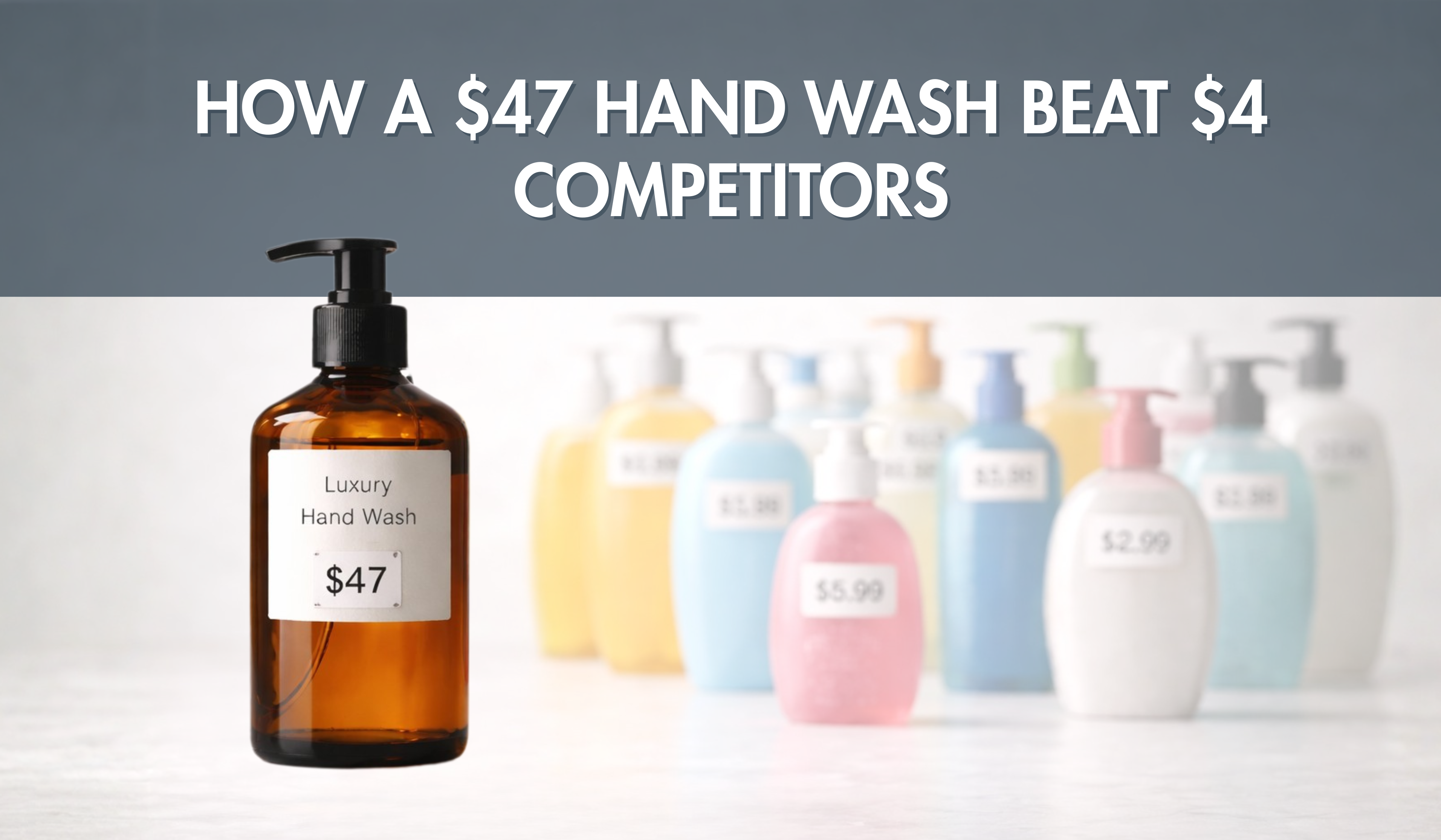
In an Amazon category where every product in the top 25 is priced under $10, a luxury Australian beauty brand achieved the seemingly impossible: ranking #12 for hand wash with a $47 product.
For context, the next premium hand wash over $30 doesn't appear until position #71.
This case study documents the strategic partnership and tactical execution that transformed a prestige brand's Amazon presence from underperforming to category-defying over 18 months.
Key Results at a Glance
The Challenge
Luxury in a Mass-Market Arena
The brand—a Melbourne-based prestige beauty company known for botanical formulations and minimalist packaging—faced a fundamental tension: how to maintain brand equity on a platform optimized for price comparison and convenience.
Amazon's algorithm favors velocity, reviews, and competitive pricing. The brand's hero product—a hand wash retailing at approximately $47—was competing against options priced 90% lower. Traditional marketplace logic suggested this was an unwinnable position.
Specific Obstacles
Price Perception Gap: Consumers searching "hand wash" on Amazon typically expect options under $10. A $47 product requires completely different positioning and conversion strategies.
Unauthorized Sellers: Third-party sellers, including retailers like Sam's Club, were listing products without authorization, causing Buy Box suppression and brand dilution.
Regulatory Complexity: New York State's ban on 1,4-Dioxane threatened to disrupt nationwide sales of affected SKUs.
Category Expansion: The brand needed to grow beyond hand and body care into skincare, fragrance, and gift sets while maintaining premium positioning.
The Strategy
Rather than competing on price, the approach focused on maximizing conversion at premium price points through superior content, strategic bundling, and data-driven advertising.
1. Data-Driven Product Bundling
Market basket analysis revealed that 8% of customers purchasing one hero hand wash variant also purchased the complementary scent. This insight drove the creation of an elevated duo set with optimized SEO and imagery showcasing each formula.
Result: The duo set achieved 1,100+ units monthly by year-end, creating a new revenue stream while increasing average order value.
Additional strategic bundles included a fragrance discovery pairing (room spray + matching perfume for cross-category discovery), refill value packs meeting high customer demand, and travel kits that grew 125% quarter-over-quarter.
2. Non-Branded Keyword Conquest
Instead of relying solely on brand-aware customers, aggressive campaigns targeted category level searches where the brand could demonstrate superior value despite higher prices
3. Continuous Listing Optimization
A/B testing through Amazon Experiments validated title and content changes before full rollout. Title optimizations incorporating benefit-driven language ("Lightweight Moisturizer," "Hydrating Ingredients") delivered measurable conversion lifts of 2-4%.
Comparison charts added to A+ content guided customers toward higher-value or complementary SKUs, lifting sales by 3-10% while building brand trust through transparent product differentiation.
4. Regulatory Navigation
When New York State enacted regulations banning 1,4-Dioxane, the response was proactive rather than reactive. Working directly with Amazon, an internal order block was secured for affected products, ensuring compliance with state regulations while allowing uninterrupted sales in other states.
This approach positioned products for seamless reintroduction upon reformulation, protecting revenue while maintaining regulatory compliance.
5. Brand-Aligned Influencer Marketing
Rather than pursuing volume-based influencer partnerships, the strategy focused on curated creators who aligned with the brand's aesthetic philosophy. Combined with partnerships across top affiliate networks, this drove qualified traffic to optimized listings.
Exclusive brand events further cultivated relationships with key opinion leaders, generating authentic content that reinforced premium positioning.
6. Storefront Optimization
Rather than treating the Storefront as a static catalog, rigorous A/B testing drove continuous optimization—experimenting with navigation architecture, seasonal page prioritization, and skin care organization by concern to match how customers actually discover and shop.
During gifting season, the storefront was reoriented to prioritize gifting pages and bundled products, with navigation redesigned for exploratory browsing. The skin care section was reorganized around shopping by skin concern, with curated routines encouraging multi-product purchases.
Results: Approximately 17% of total sales now originate from the Storefront. Dwell time per page increased by 30+ seconds during gifting season, with skin care seeing a 26% dwell time increase and 10% sales lift. Average Order Value for Storefront traffic runs 10% higher than standard search, and units per order through January surpassed peak holiday levels.
The Results
The Headline Achievement
Category Ranking Improvements
Revenue Growth Trajectory
2024 Full Year: +23% YoY
2025 Full Year: +51% YoY
Category Expansion Success
Growth extended well beyond core hand wash products, with significant gains across multiple categories:
Customer Metrics
Repeat Purchase Rate: 17.6% (+6.5% improvement)
New-to-Brand Customers: +38% YoY
Repeat Customers: +39% YoY
Outperforming the Category
Amazon's Beauty & Personal Care category grew +26% in 2024 and +13.5% in 2025. This brand dramatically outperformed those benchmarks while achieving outsized growth in key subcategories:
Key Takeaways
1. Premium Can Win on Amazon—With the Right Strategy
Conventional wisdom suggests Amazon rewards low prices. This case demonstrates that exceptional conversion optimization, strategic bundling, and relentless content refinement can overcome a 9x price disadvantage.
2. Data Reveals Unexpected Opportunities
Market basket analysis identified customer behavior patterns that informed profitable bundling strategies. The 8% cross-purchase rate between hero variants became a seven-figure revenue stream.
3. Non-Branded Keywords Drive Profitable Growth
Achieving 21-34% conversion rates on category-level searches like "hand wash" and "body cleanser" proves premium products can compete for discovery-stage shoppers when listings are optimized for value communication.
4. Operational Excellence Protects Brand Equity
Proactive regulatory navigation and unauthorized seller management prevented revenue loss and brand dilution that plague many prestige brands on marketplace platforms.
Conclusion
This partnership demonstrates that premium positioning and marketplace success are not mutually exclusive. By treating Amazon as a brand-building channel rather than a discount outlet, the brand achieved category-leading performance while maintaining the premium perception essential to its identity.
The #12 ranking for a $47 hand wash in a category dominated by sub-$10 alternatives isn't an anomaly—it's proof that strategic execution can overcome structural disadvantages.